
Roofing estimation errors eat into profit margins, create material waste, and delay insurance approvals. As the industry shifts from manual measurement methods to roofing software, understanding the accuracy rates of these tools has become essential for protecting profitability.
This analysis examines how the accuracy rates of roofing software directly impact your bottom line, from digital measurements to final invoices. Using industry benchmarks, manufacturer specifications, and real contractor performance data, we identify the key factors that drive accuracy in roofing operations: digital measurement precision, system integration, template standardization, real-time pricing updates, and automated data flow from estimate to invoice.
Digital Measurement Accuracy: What the Numbers Actually Show
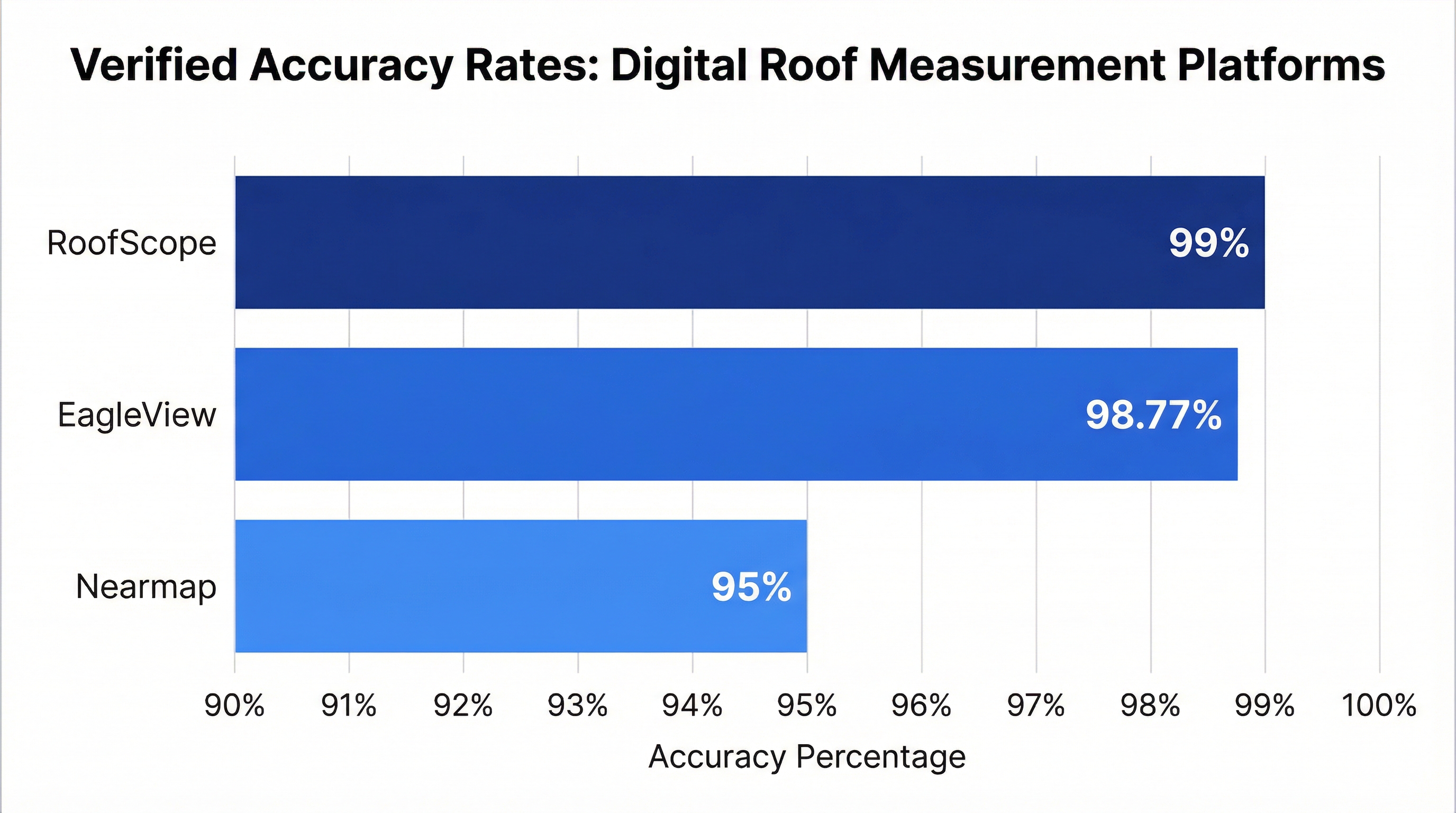
Professional roof measurement software delivers measurable accuracy standards you can rely on for precise estimates and material ordering. Leading platforms achieve accuracy rates between 95% and 99%, according to industry testing and manufacturer specifications.
EagleView’s measurements have been independently verified at 98.77% accuracy by CompassData using LiDAR technology. This independent testing, conducted in April-May 2025 on single-family residences in the Denver Metro area, found:
- Roof Linear Measurements: 98.77% accuracy (average difference: 0.2 linear feet / 2.4 inches)
- Roof Area Measurements: 98.43% accuracy (average difference: 5.61 square feet)
- Roof Slope Measurements: 98.49% accuracy
RoofScope guarantees 99% accuracy on all aerial measurement reports, even on complex roofs hidden beneath dense trees. Nearmap specifications guarantee +/-5% accuracy using proprietary 3D mesh technology.
These digital measurement tools complete roof assessments with turnaround times ranging from 1-3 hours for standard orders, with rush delivery options available in as little as 30-60 minutes. Reports provide detailed data, including total square footage, slope calculations, and material requirements. The technology eliminates common estimation errors, such as transposing numbers, miscalculating complex geometries, and inconsistent waste-factor applications.
For contractors evaluating measurement tools, understanding key data points in roof measurements and choosing the right roof measurement software can significantly impact accuracy.
The Accuracy Rates of Roofing Software: Integrated vs. Disconnected Systems
Roofing software accuracy improves significantly when measurements, pricing, and job workflows are integrated within a single system rather than managed across disconnected tools.”
Research from Deloitte shows that construction businesses use a median of 11 separate data environments, creating unnecessary duplication that costs construction leaders approximately 10.5 hours per week. Roofing contractors face the same challenge. When you’re juggling multiple disconnected applications, each handoff between systems creates opportunities for manual data entry errors, version control issues when plans change, pricing inconsistencies, communication gaps between field and office teams, and invoice discrepancies that don’t match approved proposals.
Integrated platforms eliminate these handoff errors by centralizing customer information, measurements, estimates, proposals, schedules, and invoicing within a single system that updates in real time. One source of truth means fewer errors and faster workflows.
Three Necessary Factors That Protect Your Margins
Beyond measurement precision, the accuracy rates of roofing software depend on three operational factors: template standardization, real-time pricing synchronization, and automated data flow. Look for these factors when comparing roofing software providers.
Template Standardization
Software-based estimates ensure consistent markup rules, uniform application of appropriate waste factors, comprehensive overhead cost inclusion, and accurate labor rate calculations based on actual crew production rates. The 2025 AGC Construction Hiring and Business Outlook survey of over 1,100 contractors found that 35% plan to increase investment in estimating technology, reflecting growing recognition that standardized digital processes drive profitability. Without consistent estimating processes, estimators forget line items, apply different markups, or use outdated rates, all of which erode accuracy and profitability.
Real-Time Pricing Integration
Material costs fluctuate regularly, particularly after weather events that strain supply chains. Integrated systems with supplier connections, like Zuper’s SRS Distribution integration, pull live pricing and availability, ensuring your estimates reflect current costs. Manual spreadsheet-based estimating requires you to manually update pricing, which is a task that often gets delayed or forgotten, creating gaps between estimated and actual expenses. Real-time supplier integrations improve pricing accuracy and reduce estimation errors, though contractors should still verify pricing before finalizing large material orders.
Automated Data Flow
The final accuracy driver is automated data flow between the estimate and invoice. In disconnected workflows, approved proposals don’t automatically convert to invoices, change orders get documented but not billed, and material orders don’t sync with job costing. Integrated platforms automatically convert proposals to invoices with all line items intact, update change orders in real time, and sync material costs to accounting systems for true job profitability visibility.
What Inaccuracy Costs You
Inaccuracy hits your business in three measurable ways:
Profit Impact: Measurement errors come directly out of your profit margins. On a $15,000 roof replacement with a 35% gross margin ($5,250), a 10% cost overrun reduces your gross profit to just $3,750, cutting your margin nearly in half.
Insurance Approval Delays: Insurance claims require precise documentation. When your measurements don’t match adjuster reports or your estimates contain errors, approval delays extend project timelines and frustrate homeowners. These delays tie up your crews and create scheduling chaos.
Rework and Material Waste: Inaccurate takeoffs lead to material shortages that require emergency supply runs (adding fuel costs and crew downtime) or material overages that can’t be returned. Either scenario cuts into profitability and creates operational inefficiency.
How Zuper Delivers Accuracy at Every Step
Zuper addresses every accuracy driver through comprehensive integration:
- Connected Measurement Tools: Hover, EagleView, GAF, and RoofScope integrations import aerial measurements directly into estimates, eliminating manual transcription errors.
- AI-Powered Documentation:AI Voice Notes and AI Walkthrough Notes capture roof photos and spoken notes, automatically organizing them into structured inspection records without manual data entry.
- Standardized Workflows: Customizable checklists for estimates, proposals, production, and QA ensure consistency across every job.
- Automated Data Flow: Approved proposals automatically convert to invoices with all line items intact. Change orders update billing in real time. Material orders placed through SRS Distribution integration sync costs to QuickBooks Online for accurate job profitability tracking.
Real Results:Maven Roofing reduced technology costs by $250 per employee per month, saved eight hours per person per week, lifted same-day close rates by 20%, and shortened new-hire ramp-up time by 40%.
Ready to Eliminate 8 Hours Per Week Wasted on Disconnected Systems?
The high accuracy rates of roofing software, such as Zuper, allow roofing contractors to protect profitability on every job. Explore how Zuper’s integrated platform centralizes measurement, estimating, and job management in a single system. Schedule a personalized demo to see how integrated workflows can transform your operations, or learn more about Zuper’s roofing estimate software and measurement capabilities.