
Roofing estimates can make or break project margins. A 5% labor underestimate on a $20,000 job costs you $1,000 straight from your profit. With material costs climbing and crew availability tightening, traditional estimating methods leave too much room for costly errors. An AI roofing estimating calculator changes that equation by learning from real project data to deliver faster, more accurate quotes with fewer mid-job adjustments.
Manual estimating processes built for yesterday’s market cannot keep pace with today’s volatile costs and complex projects. When your team relies on static templates and outdated pricing sheets, you risk underbidding labor or missing waste factors that force expensive mid-project resupply runs.
In this guide, you’ll learn:
- How AI-powered calculators reduce estimating time while improving accuracy
- Which data inputs drive smarter predictions and fewer change orders
- Specific features that separate basic templates from intelligent estimation
- Real operational benefits roofing teams gain from AI-assisted workflows
How an AI Roofing Estimating Calculator Improves Accuracy
Traditional estimating relies on fixed formulas and historical averages. An AI roofing estimating calculator operates differently. These systems analyze patterns across completed projects, such as material usage, labor hours, weather delays, and regional cost fluctuations, to generate estimates that reflect current market conditions rather than outdated assumptions.
The technology learns from each job. When a steep-pitch roof in a specific region consistently requires 18% material waste instead of the standard 10%, the AI adjusts future estimates accordingly. This pattern recognition extends to labor calculations, where the system factors in crew productivity data, seasonal demand spikes, and local wage rates.
Core Capabilities That Drive Improved Accuracy:
| Capability | How It Works | Impact on Estimates |
| Real-time material pricing | Connects to supplier databases for current costs | Eliminates surprises from price increases between the quote and the purchase |
| Waste factor libraries | Calculates material needs based on roof complexity | Reduces shortages that delay projects and drain profits |
| Regional labor adjustment | Applies location-specific wage data and productivity rates | Accounts for market variations that fixed rates miss |
| Historical project analysis | Reviews completed jobs to identify cost patterns | Refines future quotes based on actual performance |
By building permit fees, disposal costs, equipment rentals, and scope changes into initial quotes, AI-powered calculators give roofing teams more confidence earlier in the job lifecycle.
The Data That Makes AI Roofing Calculators Smarter
An AI roofing estimating calculator becomes more valuable as it processes more job data. Essential data categories include:
- Project specifications: Roof dimensions, pitch measurements, material selections, and complexity factors form the foundation. Integration with measurement tools such as Hover or GAF enables automated import of these specifications, reducing manual data entry and errors.
- Historical performance metrics: Completed job records provide the learning material AI systems need. Labor hours logged per square foot, actual material consumption, and crew productivity rates on similar projects feed the algorithm, creating a customized baseline that reflects your team’s specific capabilities.
- Current market conditions: Material costs fluctuate with tariffs, supply chain disruptions, and seasonal demand. Steel and aluminum tariffs recently drove roofing material costs up 25% in some regions. AI calculators that integrate live supplier pricing ensure quotes reflect today’s costs.
- Regional variables: Labor rates vary significantly by location. Average hourly wages for roofers range from $19 to $22.35 nationwide, but in urban markets they can reach $40 to $80 per hour. Effective AI systems adjust estimates based on your specific service area and current market conditions.
Key Features of Effective AI Roofing Estimating Calculators
Not all AI-powered estimating tools deliver equivalent value. Look for these distinguishing features:
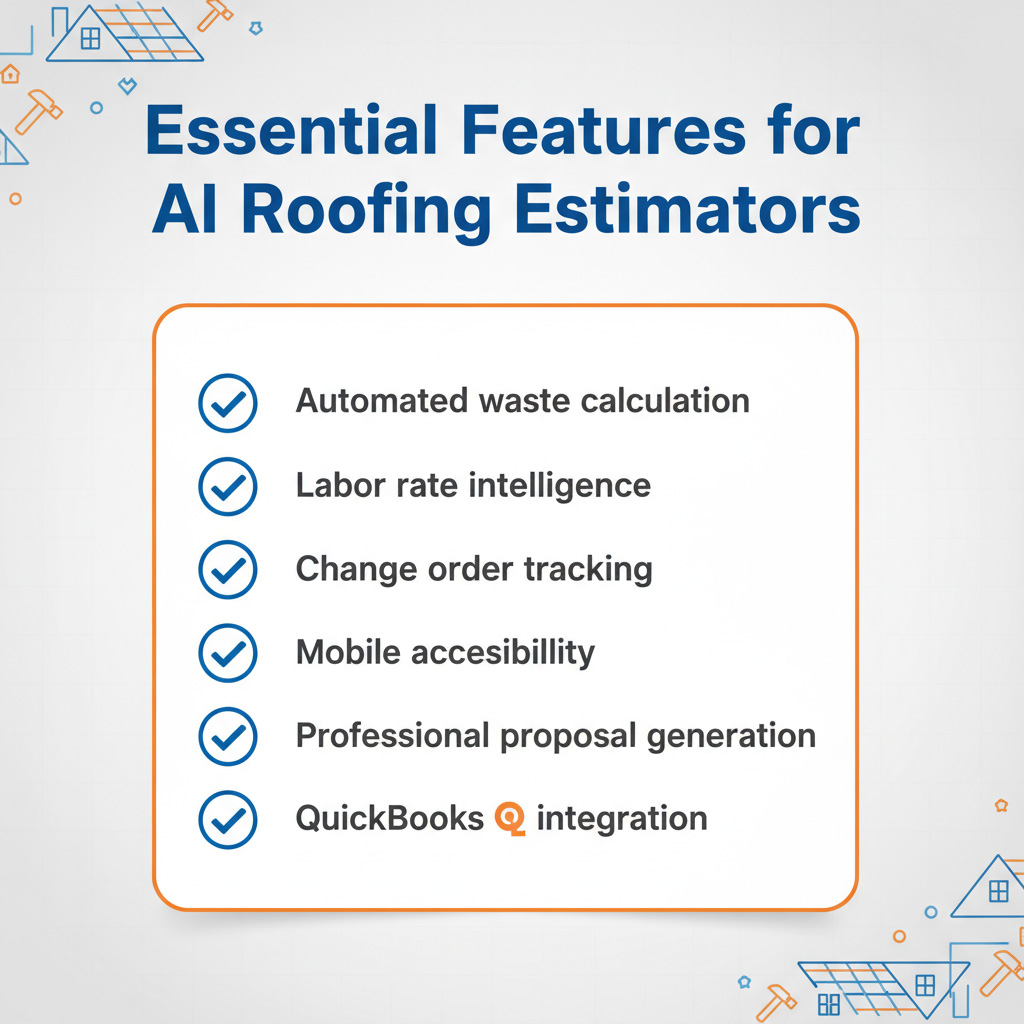
- Automated waste calculation: AI systems analyze the roof geometry, including hips, valleys, dormers, and penetrations, to calculate precise material requirements, preventing both shortages and excess orders.
- Labor rate intelligence: Advanced calculators factor in seasonal demand fluctuations, regional wage variations, and crew-specific productivity data. When storm damage spikes demand in your area, the system automatically adjusts labor costs.
- Change order tracking: Integrated change order management ensures mid-project adjustments are documented, priced, and approved, preventing the “free add-ons” that shrink profits.
- Mobile accessibility: Mobile-first platforms let crews capture measurements, document conditions, and adjust quotes in real time, with offline capability ensuring functionality regardless of connectivity.
- Professional proposal generation: The best systems automatically format quotes with transparent line items, visual documentation, and digital signature options, accelerating approval.
- QuickBooks integration: Direct integration with accounting platforms ensures estimates, invoices, and payments sync automatically, keeping financial data current without manual intervention.
Operational Benefits: Faster Quotes, Fewer Adjustments, Better Margins
The measurable impact of an AI roofing estimating calculator extends beyond accuracy improvements.
- Time savings: Manual estimating typically requires 45–90 minutes per quote. AI-powered calculators reduce this to 10–15 minutes by automating data entry, applying current pricing, and generating professional proposals automatically. For businesses quoting 20–30 jobs weekly, this translates to 15–20 hours reclaimed for revenue-generating activities.
- Reduced change orders: Projects estimated with AI systems experience fewer mid-job cost adjustments because initial quotes account for complexity factors that manual processes miss. This reduces awkward conversations with homeowners about unexpected costs and protects trust-based relationships.
- Improved margin protection: AI calculators that integrate real-time supplier pricing eliminate margin erosion from outdated price sheets. Labor calculations that adjust for seasonal demand spikes prevent underbidding that forces contractors to complete jobs at a loss.
- Faster new hire ramp-up: AI-guided estimation reduces the learning curve by embedding best practices into the calculation process. New team members can generate reliable quotes within weeks rather than months.
- Enhanced competitive positioning: The ability to provide accurate, professional estimates quickly gives AI-equipped contractors a decisive advantage. When you can deliver a detailed, transparent proposal while prospects are still on-site, complete with visual documentation and digital approval options, conversion rates improve measurably.
Zuper users report concrete results. Maven Roofing, for example, cut technology costs by $250 per employee per month, saved 8 hours per person per week, and increased same-day close rates by 20%.
Making the Transition to AI-Powered Estimation
Moving to an AI roofing estimating calculator doesn’t need to disrupt operations.
- Start with data preparation: Gather historical job records, including completed estimates, actual costs, labor hours, and material consumption. Even six months of detailed project history provides valuable training material.
- Run parallel processes initially: Continue your existing estimating workflow while simultaneously generating AI-powered quotes for comparison. Track variance between traditional and AI estimates, then compare both against actual project costs.
- Begin with straightforward projects: Use your first AI-generated estimates on standard re-roof jobs with familiar materials. As the system demonstrates reliability, progressively apply it to more complex projects.
- Leverage vendor support: Comprehensive platforms provide implementation assistance and training. Zuper’s onboarding process takes as little as four weeks, with dedicated support to ensure teams maximize platform capabilities from launch.
Most contractors report ROI within the first quarter through time savings, improved accuracy, and reduced change-order frequency.
The Future: Continuous Improvement Through AI
Unlike static templates, an AI roofing estimating calculator becomes more valuable over time. Each completed project adds data that refines future predictions, creating a continuous improvement cycle that manual methods cannot replicate.
This learning capability means the platform adapts automatically to market shifts, including material cost fluctuations, labor rate changes, and evolving project complexities, without requiring manual updates. As your business grows and tackles different project types, the AI system grows with you.
For roofing contractors operating in competitive markets and facing tight margins, adopting AI-powered estimation represents a strategic shift toward data-driven operations, where decisions rest on accurate information rather than rough assumptions.
Ready to see how an AI roofing estimating calculator protects your margins while accelerating your quote process? Schedule a demo of Zuper’s roofing platform to experience intelligent estimation built specifically for roofing contractors.